Quick Answer
PC gaming's biggest advantage is not simply that it gets major releases. It is that a large share of its value continues below the biggest games of the moment. Newzoo's Analysis of playtime and revenue beyond the Top 20 found that 56% of PC game revenue in Western markets came from titles outside the Top 20 in 2025, up from 48% in 2022. The equivalent share of playtime rose from 33% to 42%.
That does not mean blockbusters stopped mattering. It means the PC market has a stronger long tail: premium games, older releases, specialist communities, survival sandboxes, RPGs, strategy games, and other titles that keep finding players after the launch conversation moves on. For players, that creates more freedom and better value—but also a harder discovery problem.
The Top 20 is only the visible part of PC gaming
The biggest launches shape the weekly conversation because they are easy to market and easy to measure. A new open-world game, annual sports release, or major online title can dominate streams, search results, and storefront banners. That visibility can make the market look narrower than it is.
Newzoo's 2026 PC and Console Gaming Report frames the broader issue as concentration. A relatively small set of games still commands a large amount of player attention, but the share below that group is not empty space. On PC, it is becoming a meaningful part of the platform's economic identity.
This is why the long-tail statistic matters. It is not a claim that most PC players ignore new games. It is a reminder that a PC player's real library is bigger than the release calendar. The games sustaining that library do not need to win the launch week to remain useful, profitable, or culturally relevant.
PC rewards games that stay available
The PC long tail is partly a consequence of how the platform preserves access. A game can remain purchasable, patched, discounted, modded, streamed, or supported by a dedicated community long after its first marketing cycle. That does not guarantee that every older game will be easy to find, but it gives durable titles more chances to return.
Newzoo reports that playtime for PC games ranked outside the Top 20 grew 44% between 2022 and 2025, compared with 14% growth for total PC playtime. The same analysis says the group below the Top 20 skews toward premium and back-catalogue games. In other words, the growth is not only coming from a wave of brand-new free-to-play releases. Players are also spending time with games that have already proved they can last.
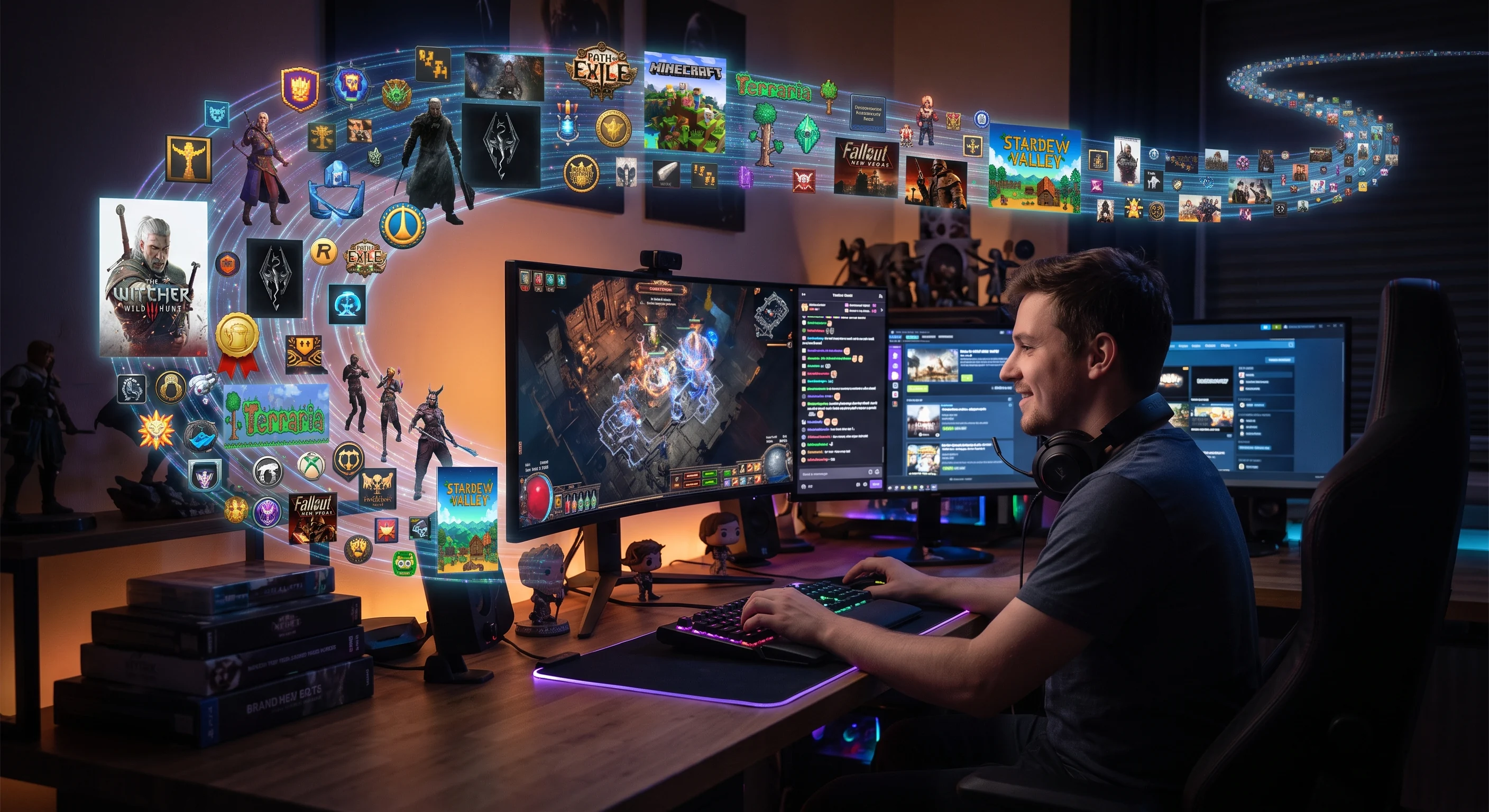
That helps explain why a game such as Skyrim, Cyberpunk 2077, Elden Ring, or a long-running survival title can remain part of the PC conversation without behaving like a current-season service. Its value is not limited to the week it launched. It can be someone else's first major game years later, or the game a returning player installs after a hardware upgrade.
The long tail is where PC feels most different
GamesRadar's Report on the PC market beyond the Top 20 highlights the variety inside that group, from Path of Exile 2 and Monster Hunter Wilds to older RPGs and persistent survival games. The important point is not the individual list. It is the mixture.
PC's long tail can include a premium role-playing game from several years ago, a new mid-budget release, a simulation with a small but devoted audience, and a multiplayer game whose community has formed its own rhythm. Those games do not compete for exactly the same player or the same evening. Their coexistence is part of the platform's appeal.
This is also why comparing PC only through its most anticipated releases misses something essential. A console launch calendar can be a useful way to decide what to play next, but PC's advantage is often the ability to change direction completely. You can move from a new release to a ten-year-old strategy game, a modded classic, or a niche co-op title without leaving the same broad ecosystem.
More choice creates a discovery tax
The long tail is good news until the library becomes too large to navigate. A player who has access to thousands of games does not automatically have a better next choice. Storefront recommendations can overexpose the same major releases, while older games can disappear beneath sales, updates, and algorithmic repetition.
That creates what I would call a discovery tax. PC gives you more potential value, but you have to do more work to identify which part of the library fits your time, hardware, friends, and current mood. The problem is not a lack of options. It is that durable games often need context before they become appealing.
This is where a small, practical system helps. GoldCrit's three-game Steam backlog shortlist treats a library as a set of possible fits rather than a debt to clear. The same principle applies to the wider PC market: keep one obvious choice, one low-friction fallback, and one curiosity pick. The goal is not to play everything. It is to make the long tail usable.
What players should look for beyond the launch window
The best long-tail games are not necessarily the oldest or the cheapest. Look for evidence that a game still gives you a clear reason to return:
- A durable loop: The core activity remains satisfying after the novelty fades.
- A healthy entry point: Tutorials, settings, community guides, or a recent update make it possible to start now.
- A suitable commitment: The game fits the time you actually have instead of demanding an imaginary free weekend.
- A reason to choose it today: A friend is playing, a new expansion landed, a mod changed the experience, or the game's style matches what you want.
This approach also protects players from mistaking longevity for quality. A game can remain visible because of brand recognition rather than because it is the right use of your time. The long tail is an opportunity, not a command to excavate every classic in your library.
PC's real advantage is choice that survives the news cycle
New releases still provide the shared moments that make gaming feel current. They bring communities together, set technical expectations, and give players a reason to talk about the same thing at the same time. PC gaming's long tail does not replace that energy.
It gives the platform a second layer of value. When the next major launch is delayed, expensive, badly optimized, or simply not your kind of game, PC still has a deep supply of alternatives that are not leftovers. They are the durable middle of the market: games with enough identity, depth, and accessibility to keep earning another evening.
That is why the long tail matters more than a release calendar alone. The future of PC gaming is not only decided by which game opens at number one. It is also decided by which games remain worth finding after the headlines have moved on.