
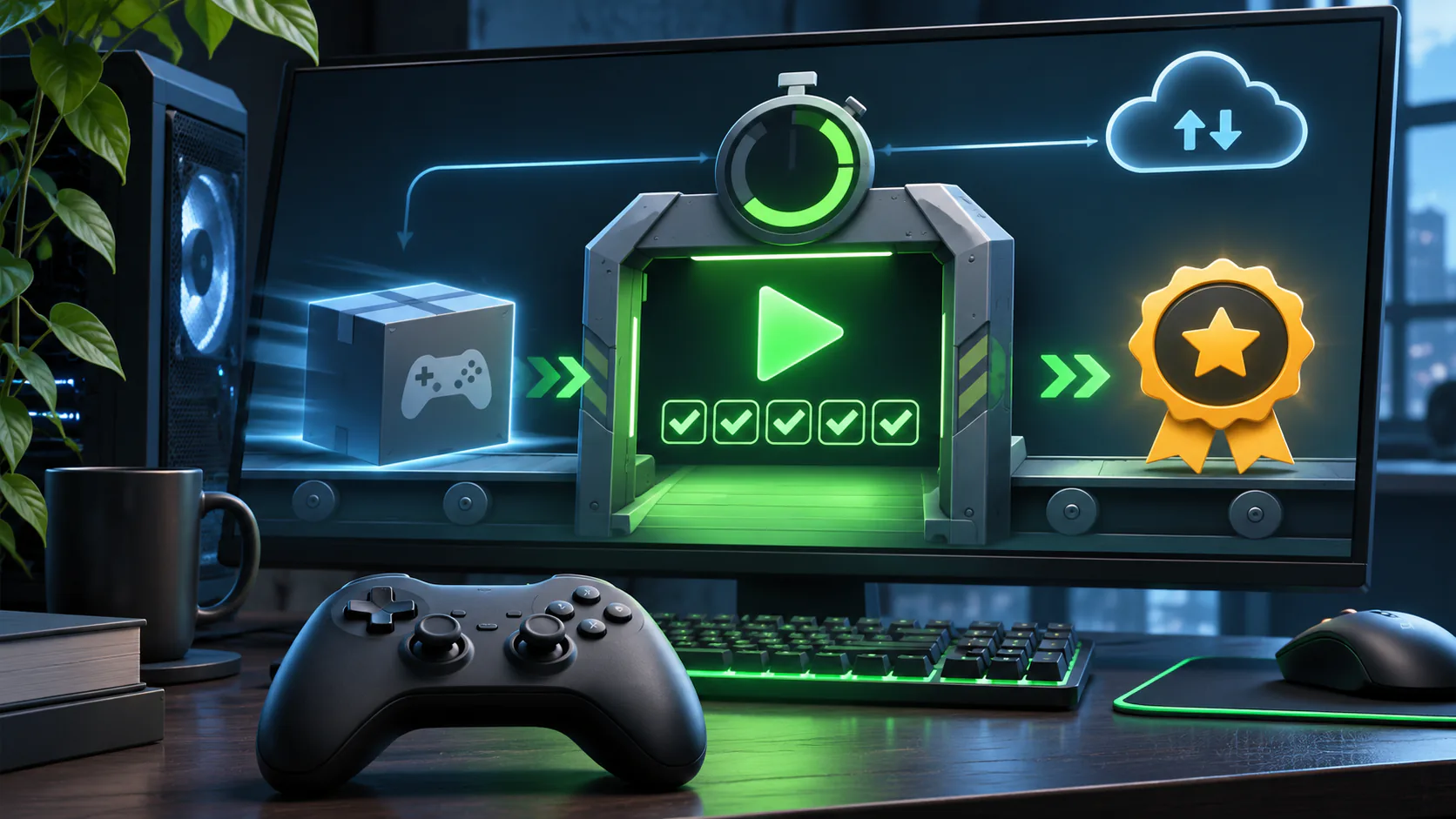
Before submitting a build for review, developers must now make sure it has been launched through Steam and played for at least five minutes. Steamworks says the qualifying playtime can come from any user. The new check sits alongside reminders about redistributables, achievements, Steam Cloud saves, and store-page assets. Valve says some reviews are currently taking up to 12 business days, but the checklist is meant to reduce avoidable re-reviews—not promise a shorter wait.
Key changes
- Run the latest build through Steam’s green Play button for at least five minutes; any user’s qualifying playtime counts.
- Confirm the required common redistributables, or mark that none are needed.
- Resolve incomplete or duplicate achievement names and missing icons.
- If Steam Cloud is supported, test a save from a partner-group account and switch off developer mode.
- Check store media and promises: five gameplay screenshots, correct image categories, promised languages, and multiplayer reviewer credentials where needed.
What developers must check before review
The five-minute check is a pre-submission requirement, not a request to test only after a reviewer opens the build. Launch the latest build with Steam’s green Play button and run it for at least five minutes. Any user’s playtime is valid. Steam checks for a run in the previous seven days; if the build was uploaded more than seven days ago, a run since that upload counts. Valve says launching through Steam can expose issues a direct run from a development folder may miss, such as incorrect launch options or missing content depots.
The checklist also asks developers to confirm which common redistributables—such as DirectX or Visual C++—a game needs, or to say that none are required. Achievement checks flag incomplete setup such as missing names or icons and duplicate names. If a store page lists Steam Cloud support, a member of the developer’s partner group must write a save to the service; Steam also flags Cloud configurations left in developer mode.
Other reminders depend on what the game’s store page promises. A multiplayer title may need reviewer credentials, for example, while a game advertising several languages must include those languages in the build. The point is to catch mismatches before a reviewer has to send a submission back. Valve’s Steamworks announcement says these checks are intended to help more releases pass review the first time.
Store screenshots get clearer labels
Developers still need at least five screenshots categorized as gameplay. They can also submit menu images, concept art, and stills from in-game cinematics, but must assign the correct category; those labels appear with the images on the store page. Marketing copy remains disallowed in screenshots.
For buyers, that distinction is useful when a store carousel mixes gameplay images with concept art. The timing may invite comparisons with AI-generated store media, but Valve’s update attributes review pressure to higher submissions and re-reviews; it does not announce an AI-specific change. Game*Spark’s report likewise says the screenshot update is not presented as a direct anti-AI measure.
What PC players should take from it
The five-minute run is a basic launch-path check. It can catch a build that fails to start correctly through Steam or is missing content, but it does not amount to a long-session stability test across different CPUs, graphics cards, drivers, or Windows setups. The checklist is also not a Steam Deck verification or a performance guarantee. Keep checking a game’s published PC requirements and feature notes when deciding whether it fits your system.
The review backlog matters more immediately to developers planning release dates. Valve says the usual target is three to five days, but some current reviews are taking up to 12 business days, with repeated reviews contributing to the delay. The new checklist is meant to reduce that churn; Valve has not promised that the queue will shorten on a set schedule. Insider Gaming’s coverage likewise reports the new checks alongside the longer current wait.
For players, the reasonable expectation is narrower: store images should be easier to interpret, and Steam is asking studios to verify a few practical setup details before release. That may prevent some avoidable launch problems, but it cannot tell you whether a game will run well on your particular PC.